Stationary terminals
When stability is crucial
Where payments are always made in the same place, the requirements change. Speed, reliability and clear processes are coming to the fore. The terminal becomes an integral part of the work process – not a mobile support.
Stationary terminals come into their own where reliability is more important than flexibility. Differences are less apparent in the range of functions than in the way they are integrated into existing processes.
Overview of suitable stationary terminals
All stationary terminals shown here meet the current requirements for card payments in the Swiss market, including the EP2 standard. They support common debit and credit cards as well as contactless payments and are designed for permanent use at fixed checkout locations.
It is not the basic functions that are decisive, but the details in everyday life: operation, response time, integration and the ability to work reliably even under high utilization.
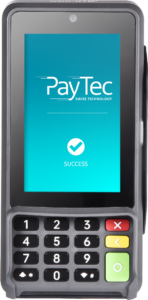
How stationary terminals differ in everyday life
Even with stationary terminals, differences only become apparent in daily use. The positioning at the checkout, the connection to the checkout and the type of operation influence how smoothly payments are processed.
Display size, response speed and connection to existing systems play a greater role than additional functions. Especially in busy environments, a clear process is crucial for efficiency.
Typical application scenarios
Stationary payment terminals are primarily used where payments are made on a regular and structured basis:
- Checkout stations in the retail trade
- Bars and fixed service points in gastronomy
- Reception & check-in in hotels and service companies
- Companies with clearly defined payment processes
In these environments, payment becomes routine – and this is precisely where its strength lies.
What is important when making a selection
Before deciding on a model, it is worth taking a sober look at your own checkout process. How high is the daily payment throughput? How closely must the terminal interact with the existing checkout – via OPI, ZVT or KIT? How important are response times and ease of operation when things need to move quickly at the checkout?
Those who know this will find the right appliance more quickly – and won’t be surprised afterwards.